Weighted Linear Local Tangent Space Alignment via Geometrically Inspired Weighted PCA for Fault Detection
Abstract
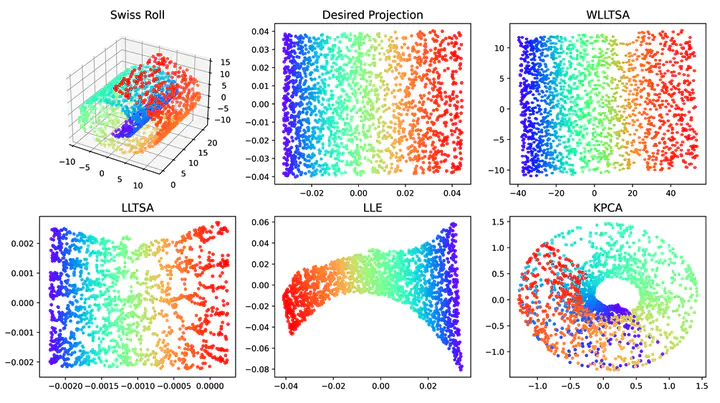
Principal component analysis (PCA) is widely adopted in local tangent space alignment (LTSA) to estimate local tangent spaces. These estimates are only accurate when uniformly distributed data lies in or close to linear subspaces. In practice, such conditions are rarely satisfied. Therefore, this approach fails to reveal manifold intrinsic features, resulting in degraded fault detection accuracy. Considering the drawbacks, weighted linear local tangent space alignment (WLLTSA), a manifold learning method is put forward. First, weighted PCA is adopted to provide local tangent space estimates. The parameter selection criterion for the weight matrix is established by taking the context of geometric preservation into account. Second, global low dimensional coordinates are formed by aligning local coordinates with global feature space. Finally, the fault detection model is developed, and KDE is utilized to approximate confidence bounds for T^2 and SPE statistics. WLLTSA is applied to fault detection and feature extraction.